When choosing a topic for an article, it is necessary to take into account not only research interests, but also current scientific trends. In this article we will tell you what research trends and topics will be in demand in Web of Science in 2025-2026.
Reasons for the emergence of trends in scientific publications
The emergence of new trends in scientific publications is the result of a complex interaction of many external and internal factors. The main ones are listed below.

- Societal needs and challenges – stimulate research to address pressing social, environmental, and health issues.
- Technological advances – open up new areas of research through the development of tools, methods and digital platforms.
- Priorities of the state and funding organisations – determine the topics of scientific projects through the distribution of grants and programme support.
- Public interest and media attention – increase the attention of the scientific community to topics widely discussed in the public space.
- Global events and political changes – shape the scientific agenda, especially in the context of crises, pandemics and geopolitical transformations.
General trends of scientific publications in Web of Science 2025-2026.
1. Increase in the number of interdisciplinary studies
Modern scientific problems require an integrated approach that brings together knowledge from different fields of science. Research at the intersection of several disciplines, such as artificial intelligence in medicine or sustainable development in the context of economics, is becoming increasingly popular. Web of Science journals are eager to publish such articles, providing a platform for publishing research papers across traditional disciplinary boundaries.
2. Sustainable Development
The UN Sustainable Development Goals (SDGs) and the principles of environmental, social and corporate responsibility (ESG) continue to be popular topics of academic research. Publications on climate change, social justice and sustainable economic growth receive high citations and attention from the scientific community.
3. Publishing in Open Access journals
The Open Access trend continues to gain momentum. Publishing in Open Access journals ensures wider dissemination of scientific results and increases their citation rate. In addition, there is an increasing emphasis on data transparency and the ability to replicate research, which helps to build confidence in scientific results.
4. Increased monitoring of ethical standards
As the number of scientific publications increases, the scrutiny of scientific ethics increases. Web of Science journals require authors to disclose potential conflicts of interest and confirm compliance of research with ethical standards. An obligatory part of the publication process is plagiarism check and verification of the submitted data.
5. International cooperation and globalisation of science
Publications produced by international scientific projects receive greater recognition and citations. Global challenges, such as pandemics or climate change, require joint efforts of scientists from different countries, which favours the development of international scientific networks and improves the quality of research.
Promising areas of science in 2025-2026 for Web of Science
We have analysed both established and emerging publication trends in the Web of Science database and are ready to present the most promising areas of science for 2025-2026.
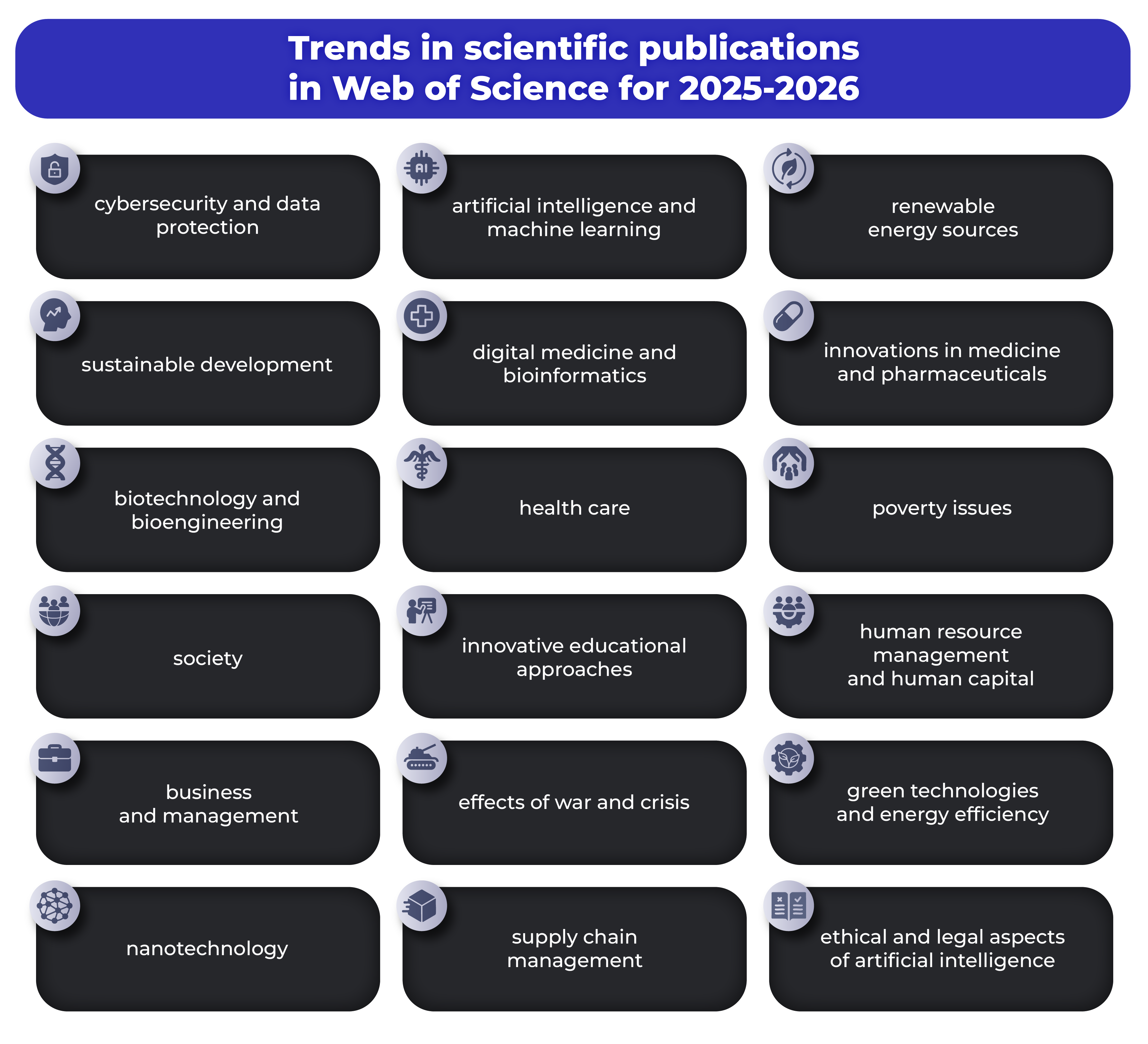
These areas are likely to receive increased attention and investment as scientists strive to find solutions to complex problems and lead society towards a more sustainable and technological future.
Need professional help with publishing a scientific article in Web of Science?
Our experts will help you choose a relevant area of research that corresponds to current trends, and provide full support at all stages of preparation and publication of the article in WoS.
Get a free consultation - just leave your contact details in the form below and our manager will contact you within a working day!