Publication ethics is not a formality, but the foundation of scientific honesty. Adherence to its principles ensures the integrity of the scientific process and contributes to the sustainable development of science. Authors, editors and reviewers have a shared responsibility to ensure that publications remain a reliable source of knowledge.

What are publication ethics?
Publication ethics is a set of norms, rules and standards governing the behaviour of authors, reviewers, editors and publishers in the process of scientific publication. Adherence to these principles ensures the integrity, transparency and credibility of scientific research.
Why do we need ethics in scientific publishing?
With the growing number of scientific publications and competition for the attention of the academic community, publication ethics serve as a basis for trust in science. They allow:
- prevent plagiarism
- protect the rights of authors and research participants
- ensure transparency of the peer review process
- preserve the scientific reputation of researchers and journals.
According to the Committee on Publication Ethics (COPE), the main challenge is to maintain high standards in academic publishing and ensure good practice at all stages, from article submission to indexing in an international database.
Major violations of publication ethics:
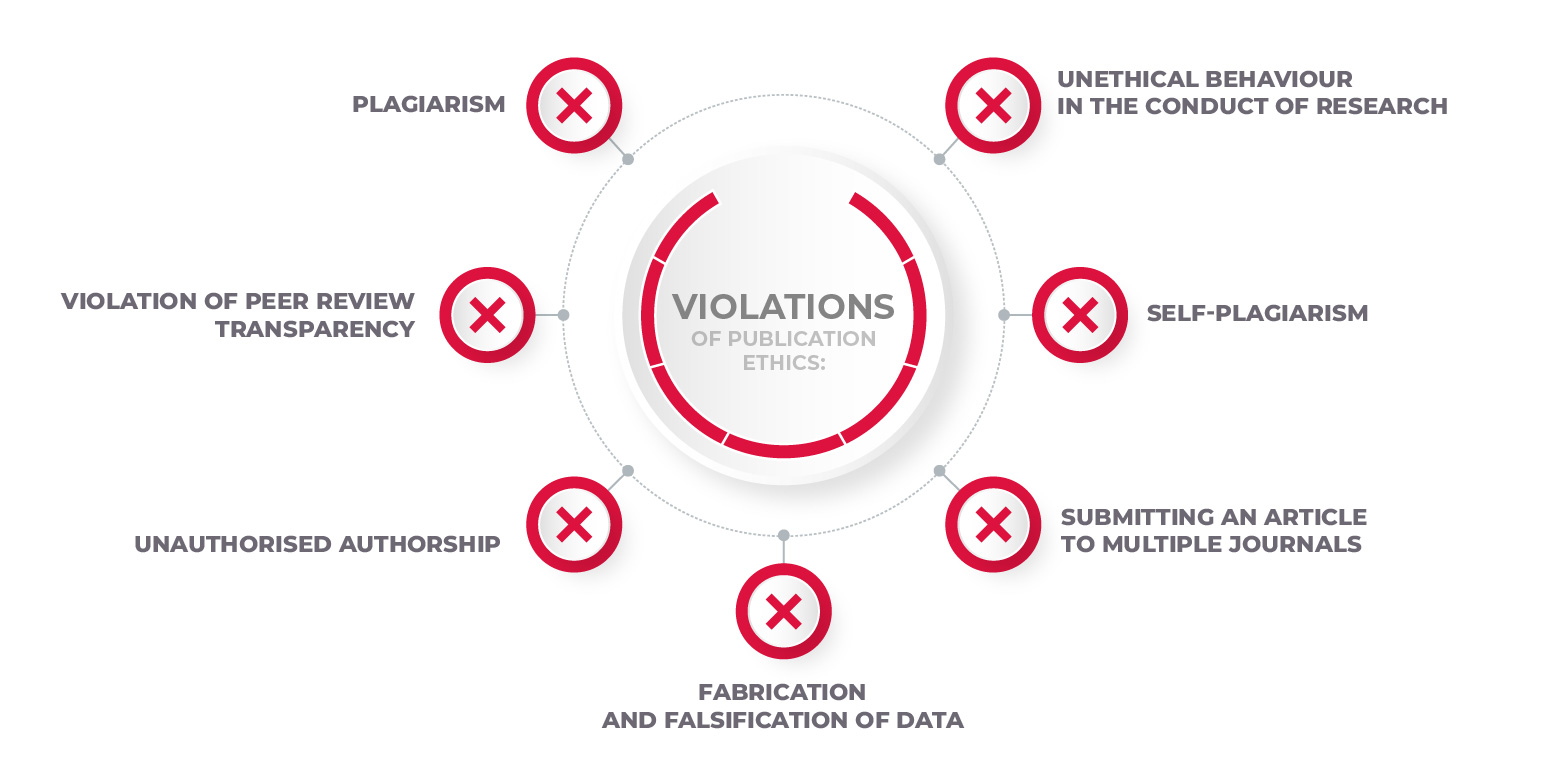
1. Plagiarism
Plagiarism is the use of other people's texts, ideas, data, illustrations or research results without proper attribution and without the author's consent. It can be either direct copying of paragraphs from someone else's article or retelling of someone else's ideas without proper attribution. Plagiarism violates copyright, undermines the credibility of the author, and can lead to withdrawal of the article, disciplinary action, or even legal action.
2. Self-plagiarism
Self-plagiarism occurs when an author reuses his or her own text, illustrations, or data that has been previously published without citing the original source. Although the materials belong to the author himself, their representation as new is misleading to readers and editors. This is particularly problematic when the same text is submitted to several journals under the guise of original research.
3. Inappropriate authorship
Misattribution includes two common violations: the inclusion in the authorship list of individuals who have not actually contributed to the work ('honourable' authorship) and, conversely, the exclusion from authorship of those who have made substantial contributions. Such practices violate fair recognition of researchers' contributions and misrepresent the scientific contributions of particular individuals. Ethical standards require that authorship reflect the real contribution of each participant to the research and publication.
4. Fabrication and falsification of data
Fabrication of data is the invention of non-existent results or experiments. Falsification is the distortion or falsification of already existing data, such as removing inconvenient results or manipulating images. Both of these behaviours constitute a gross violation of scientific ethics and can lead to serious consequences not only for the reputation of the author, but also for the scientific community at large, which runs the risk of operating with false conclusions.
5. Submitting an article to several journals
Simultaneous submission of the same article to several scientific journals is a gross violation of ethical standards. Such behaviour increases the burden on editors and reviewers, violates the exclusive rights of the publisher and can lead to double publication. If such behaviour is detected, it often leads to immediate rejection of the article in all involved journals and loss of credibility of the author.
6. Violation of review transparency
Reviewing should be fair, objective and confidential. Biased evaluation of an article, disclosure of confidential information, using the data of a peer-reviewed paper for one's own purposes or submitting a knowingly biased review is considered an offence. Such actions undermine the credibility of the peer review system and question the quality of published research.
7. Unethical behaviour in the conduct of research
This covers a wide range of misconduct, including failure to obtain informed consent from participants, experimentation on humans or animals without ethical standards, concealment of potential risks, and bias in the interpretation of results. Ethics violations at the research stage call into question the validity of the findings and violate fundamental principles of respect for human beings and nature.
The consulting company "Scientific Publications" is a leader in the field of scientometrics and science. Since 2016, we have been providing unique and quality intermediary science publishing services to scientists around the world. Our impeccable reputation is confirmed by successful scientific projects, signed memorandums with universities and scientific organisations, as well as numerous testimonials from satisfied clients.
To learn more about the terms of cooperation with us, leave your contact details in the form below. Our manager will contact you for a detailed consultation.