Publication of research results in peer-reviewed journals is a key stage in the scientific career of physicians. It is worth noting that writing a scientific article may seem like a daunting task, but if you follow a clear structure and rules, this task becomes much easier.
The complexity of writing a scientific article on medicine
-
Choosing a topic: the topic should be relevant, have scientific novelty and practical value.
-
Data collection and analysis: requires careful processing of a large amount of information from various sources.
-
Volume and detail of data: Medical articles often require a large amount of data, research results, and methodology details. It is necessary to ensure that the results are clear and valid.
-
Statistical analysis: Many medical studies require the use of complex statistical methods. The author should have the skills to analyze data and interpret statistical results.
-
Medical terminology: the use of correct medical terminology is a key aspect of writing an article. Lack of understanding or incorrect use of terms can affect the credibility and clarity of the paper.
-
Correctness and ethics: It is important to adhere to ethical standards and requirements for data presentation. Incorrect or false statements can affect the credibility of a study.
-
Peer review: Before an article is published, it is usually reviewed by experts in the field.
Trends in 2024 in choosing a topic for a medical article
Before you start writing an article, it is important to choose a topic that is relevant and of high scientific value. Let's look at a few key trends for this year.
Articles dedicated to COVID-19 in 2020-2021 have lost their relevance, but research related to post-COVID syndrome will remain popular for a long time. Research topics may include the development of new methods for diagnosing and treating diseases caused by coronavirus infection.
Topics related to the introduction of the latest technologies in medicine, such as 3D printing, artificial intelligence, and telemedicine, also remain in trend.
Particular attention should be paid to psychology, psychiatry, and psychiatric rehabilitation. These fields have gained considerable interest in recent years. Topics related to child psychology, post-traumatic stress disorder, and other aspects remain relevant.
Writing an article and structuring it
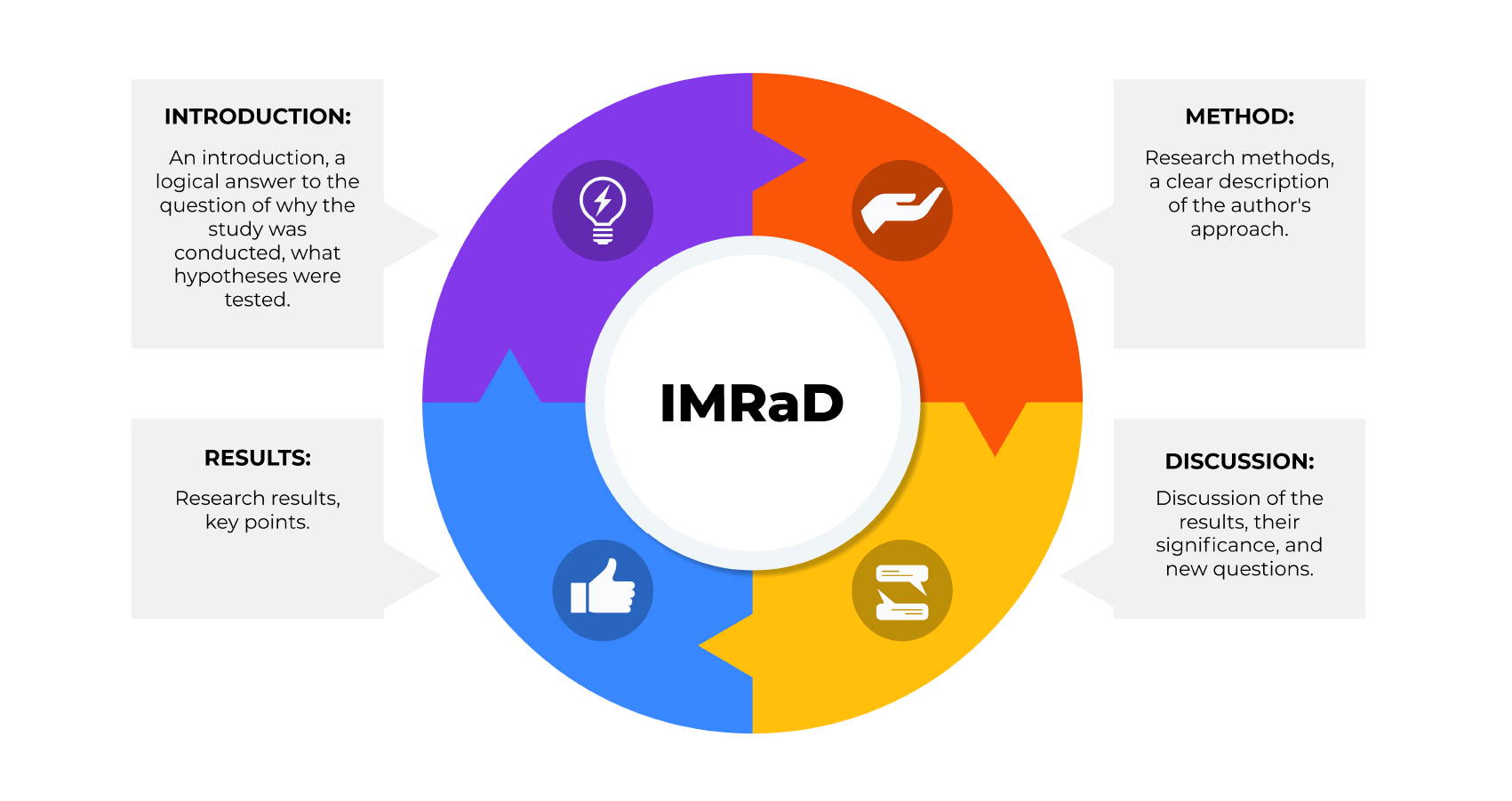
IMRAD (or IMRaD) is a commonly accepted structure for scientific articles based on empirical research. The name comes from the first letters of the four main sections:
"I" - Introduction
"M - Method
"R - Results
"D" - Discussion
Let us consider each structural element of a scientific article:
The Introduction section provides a logical answer to the question of why the study was conducted in the first place and what hypotheses the researcher was trying to test. These aspects are determined by the researcher when planning the work, so writing this part should not cause significant difficulties.
In the Methods section, it is important to clearly describe the author's approach and the methods used and their purpose. Some experts recommend starting with this structural part of the article.
Next, you should move on to the Results section, where you should present the main findings of the study.
In the Discussion section, you should evaluate what has been studied within the identified topic and what new aspects this research opens up.
After completing the main sections of the paper, you should summarize the results and summarize the findings.
Recommended databases in medicine
-
BIOSIS Previews. This is an English-language bibliographic database with abstracts and citation indexing. It is part of the Web of Science package from Clarivate Analytics and covers a huge amount of information on life sciences. BIOSIS Previews indexes data from 1926 to the present, making it a valuable resource for researchers looking for scientific articles, abstracts, books, and even patents in relevant disciplines such as botany, microbiology, and pharmacology.
-
Cochrane Collection Plus. It is a subscription-based database created by Cochrane. Cochrane is a reputable non-profit organization that reviews medical research. The Cochrane Collection Plus contains high-quality, independent systematic reviews of the effects of medical interventions.
-
Dentistry & Oral Sciences Source. This is a bibliographic database focused on research in the field of dentistry. It provides access to articles, theses and dissertations on a variety of topics related to dentistry.
-
GIDEON (Global Index of Epidemiological Studies) is a free database of published literature on epidemiology and public health. It is a valuable resource for researchers looking for studies on the incidence, prevalence, and patterns of disease.
-
International Pharmaceutical Abstracts. This is a comprehensive database of information about pharmaceuticals and drug therapy. It provides access to articles, book chapters, and other resources on a variety of topics related to drugs and medicines.
-
Natural & Alternative Treatments. This is a database that contains information about complementary and alternative medicine. It contains articles, reports, and other resources about various methods of alternative medicine.
-
Scientific & Medical ART Imagebase. The database provides access to millions of medical and scientific images and illustrations. It is a valuable resource for researchers, teachers, and healthcare professionals.
-
MEDLINE Complete. It is a bibliographic database that provides access to the MEDLINE database of the US National Library of Medicine, as well as to additional biomedical journals. MEDLINE is one of the most comprehensive medical literature databases in the world.
Submitting your work for publication
The final step is to submit your article to a journal. To do this, you need to:
-
Select a journal that matches the topic of your article.
-
Familiarize yourself with the journal's article submission guidelines.
-
Prepare a cover letter in which you describe your article and explain why it will be of interest to the journal's readers.
-
Submit your article online.
As a result, your article may:
-
Published: the scientific article meets the requirements, the author is informed about the inclusion of the work in the relevant issue of the journal.
-
Send for revision: in general, the work meets the level of a scientific journal, but some inaccuracies should be corrected.
-
Reject: the paper does not meet the requirements of the journal, it is necessary to take into account the edits of editors and reviewers and send the paper for review to another journal.
At this stage, you should engage in a constructive dialog with the journal's representatives, respond to correspondence and provide the necessary clarifications.
For the successful publication of your article and the realization of all scientific goals, we recommend that you contact Scientific Publications. Choose our service "Publication of a scientific article in medicine" and get full support of your article and guaranteed publication in medical journals!