Publishing an article in a peer-reviewed medical journal is a complex and time-consuming process that can take months, sometimes even years. How to publish medical research faster? In this article, we offer a look at effective methods to speed up the process of publishing in medical journals.
How long does it take to publish a medical research article?
Typically, the process of peer review and publication in prestigious medical journals can take a long time — from 3 months to a year or more. Publishing a scientific article in the field of medicine includes such steps as:
- preparation and writing of the article
- selection of a scientific publication
- peer review
- revisions according to reviewers' comments
- final editing and layout
- direct publication (placement of the article in the journal issue).
Each of these stages can take from one to several months.
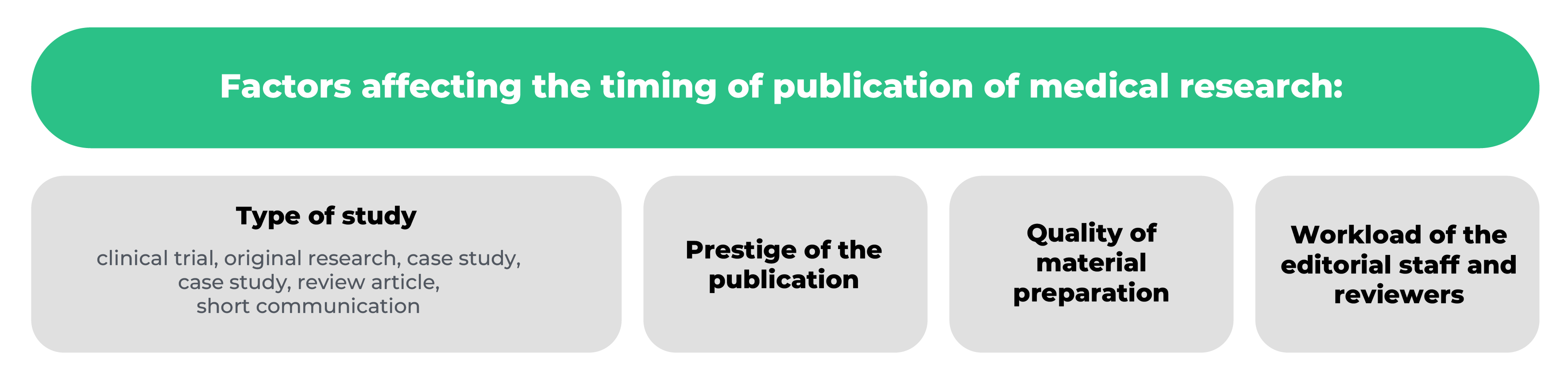
We have prepared tips to help speed up the process of publishing scientific medical articles.
How to speed up publication in medical journals?
1. Choosing the right medical journal
Choosing the right journal is one of the most important steps towards successful publication. Choose a medical journal based on the topic of your research. Make sure that the journal is suitable for your research purpose. When choosing a publication, also take the following aspects into consideration:
- scientometric metrics such as impact factor, quartile and percentile (the higher the metrics, the more difficult it is to publish a study in a journal)
- review timelines (this information can often be found on the journal's website)
- frequency of issues. The more frequently the journal is published (e.g., monthly or quarterly), the faster the article can be published.
2. Preparation of the manuscript according to the journal requirements
A well-prepared article reduces the likelihood of rejection or the need for significant revisions. Carefully follow all the guidelines for authors, which are listed on the journal's website. The more precisely you comply with the requirements when submitting your paper, the less time it will take for revisions and reconsideration by reviewers.
The basic requirements that are usually found in guidelines for formatting the text of articles are:
- font size, style, and color
- word limits
- allowable number of tables, figures, and references
- possibility to add additional materials.
3. Writing a cover letter
The cover letter is the first thing the editor will read when reviewing the application. Above all, it is important for you to convince him/her of the importance and relevance of your clinical or original research. Editors are quick to make review decisions, so it is important to convey right away why the work is valuable and why you think the journal should be interested in it. A well-written letter with a clear structure and no unnecessary information helps the editor to make a quicker decision.
4. Assistance of professional editors
Errors in the text of an article or poor quality of English can lead to a request for revision, which slows down the publication process. Professional editing and translation services can help avoid such delays, especially if the article is written by an author whose native language is not English.
The technical department of Scientific Publications employs experts in editing and translation into academic English. They are aware of all the requirements needed to publish an article in such prestigious databases as Scopus and Web of Science. You can trust specialists to check your article and start new research.
5. Effective communication with the editorial board
Try to respond quickly to reviewers' questions and comments and make edits promptly if necessary. Good reviewers usually ask detailed questions that require a reasoned response. Quick and quality answers, as well as prompt revision of the article will help to reduce the review time and, consequently, the process of placing the paper in a medical journal.
By implementing these strategies, you increase your chances of faster publication in medical journals indexed by Scopus and Web of Science.
Best medical journals for publishing scientific articles
|
№ |
Title of the journals |
CiteScore |
Percentile |
SNIP |
|
1. |
Ca-A Cancer Journal for Clinicians |
873.2 |
99% |
167.948 |
|
2. |
Nature Reviews Molecular Cell Biology |
173.6 |
99% |
19.301 |
|
3. |
The Lancet |
148.1 |
99% |
23.15 |
|
4. |
New England Journal of Medicine |
145.4 |
99% |
14.0 |
|
5. |
Nature Reviews Cancer |
111.9 |
99% |
11.501 |
|
6. |
Cell |
110.0 |
99% |
7.55 |
|
7. |
Nature Medicine |
100.9 |
99% |
8.987 |
|
8. |
Nature Reviews Clinical Oncology |
99.4 |
99% |
10.846 |
|
9. |
Nature Reviews Immunology |
93.4 |
99% |
6.796 |
|
10. |
The Lancet Respiratory Medicine |
87.1 |
99% |
8.252 |
Publishing medical research is a lengthy process that begins with selecting the right publication. At Scientific Publications, we have experienced experts who can help you select the medical journal that is most appropriate for the topic of your article and your scientific goals. For over 8 years, we have been helping scientists from around the world publish scientific articles in such prestigious databases as Scopus and Web of Science.
Leave a request in the form below and our manager will contact you within a business day for a free consultation.