Web of Science (WoS) is a leading scientific database that includes high quality and authoritative journals in various fields of science. Choosing the right journal will help to maximize the number of citations of your article and positively affect its rankings. How not to make a mistake with the choice of a journal in Web of Science? We will tell you in this article.

Selecting a journal in Web of Science: step-by-step instructions
Step 1: Web of Science Core Collection of indexes
Web of Science is the largest abstract database, which includes a record number of scientific publications (more than 21 thousand unique journals). Web of Science Core Collection was created to navigate through the large number of publications. The collection includes 7 core indexes covering various disciplines. Among them:
-
Science Citation Index Expanded (SCIE) - natural, exact and technical sciences
-
Social Sciences Citation Index (SSCI) - social and behavioral sciences
-
Arts & Humanities Citation Index (A&HCI) - arts and humanities
-
Emerging Sources Citation Index (ESCI)-all disciplines
-
Book Citation Index (BCI) -- all disciplines
-
Conference Proceedings Citation Index (CPCI) - all disciplines
-
Current Chemical Reactions (CCR) and Index Chemicus (IC) - chemical sciences.
If your research is in the exact or technical sciences, you should focus on the SCIE citation index. For research in the social and behavioral sciences, the SSCI is the best choice. Three of the seven Web of Science Core Collection indexes cover all disciplines and are also suitable for interdisciplinary research - ESCI, BCI, CPCI.
Step 2: Use the official Web of Science tools
Web of Science offers specialized tools that make it easy to find journals that are appropriate for your publication. One such tool is the Master Journal List, which displays all journals indexed in Web of Science. In this resource, you can search for journals by various criteria: subject, keywords, and field of study.

You will get relevant results in the search engine, where all WoS editions matching the given parameters will be displayed.

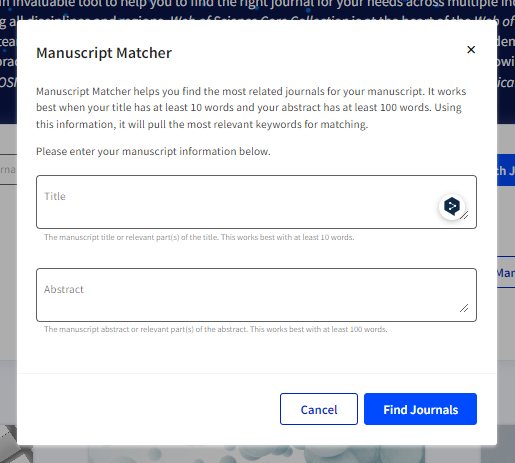
Another tool available on the Web of Science platform that helps authors find the right journal to publish their research paper is Match Manuscript. This tool is especially useful for researchers who have a research paper already completed. The service helps you find relevant, authoritative journals for potential publication of your research by analyzing thousands of journals in the Web of Science Core Collection.
Match Manuscript allows you to upload or enter key information about your manuscript (such as title, abstract, keywords, or the text itself), after which it analyzes the content of the article and suggests a list of journals that best match your research topic.
Step 3: Examine the objectives and requirements of the journal
The most common reasons for rejection of a publication are that the topic of the research paper does not match the journal's goals and subject matter, and that the journal's standards and guidelines for materials are ignored. Journals are usually very specific in their specialization. Familiarize yourself with the list of subject areas the publication deals with before submitting an article for consideration. Clearly follow the guidelines for the type of articles the publication accepts. If you have prepared a review article, but this format is not on the list of recommended publication types, there is a good chance that your research will be rejected.
Step 4: Evaluate peer review and publication timelines
It is equally important to consider the journal's peer review system. Web of Science includes mainly journals with double-blind peer review system, which guarantees an objective assessment of the work. However, there are journals that utilize open reviewing.
If it is important for you to publish a short time, pay attention to the average length of the review and publication process. These processes can take a considerable amount of time, from several months to a year.
Step 5: Compare journals based on citation rates
To select a journal, it is important to consider its citation rate and visibility in the scientific community. The Journal Impact Factor gives an indication of how sought-after a journal's articles are among scientists and how often they are cited. Another important metric for evaluating journals is the Journal Citation Indicator, a metric used by Web of Science to evaluate the impact of scholarly journals, which covers a time span of three years and is normalized by discipline, making it a universal indicator.
Following these guidelines will help you find the most appropriate publication to successfully publish your research.
Publication in the international database Web of Science is the goal of every scientist who strives to achieve worldwide recognition, to get a desired position in a prestigious institution or a grant for future research. Publication in WoS opens many perspectives to the researcher and contributes to the development of his career.
Still have questions regarding publishing research in the Web of Science? Ask our experts for help and get professional advice today!