The choice of scientific article type affects not only its structure but also how the editorial team will assess the manuscript. Each article format has a different purpose and content requirements. A mismatch between the format of the work and the journal's editorial policy may result in rejection even before peer review begins. Therefore, when preparing a publication, it is important to consider not only the scientific quality of the material but also which article type it is suitable for.
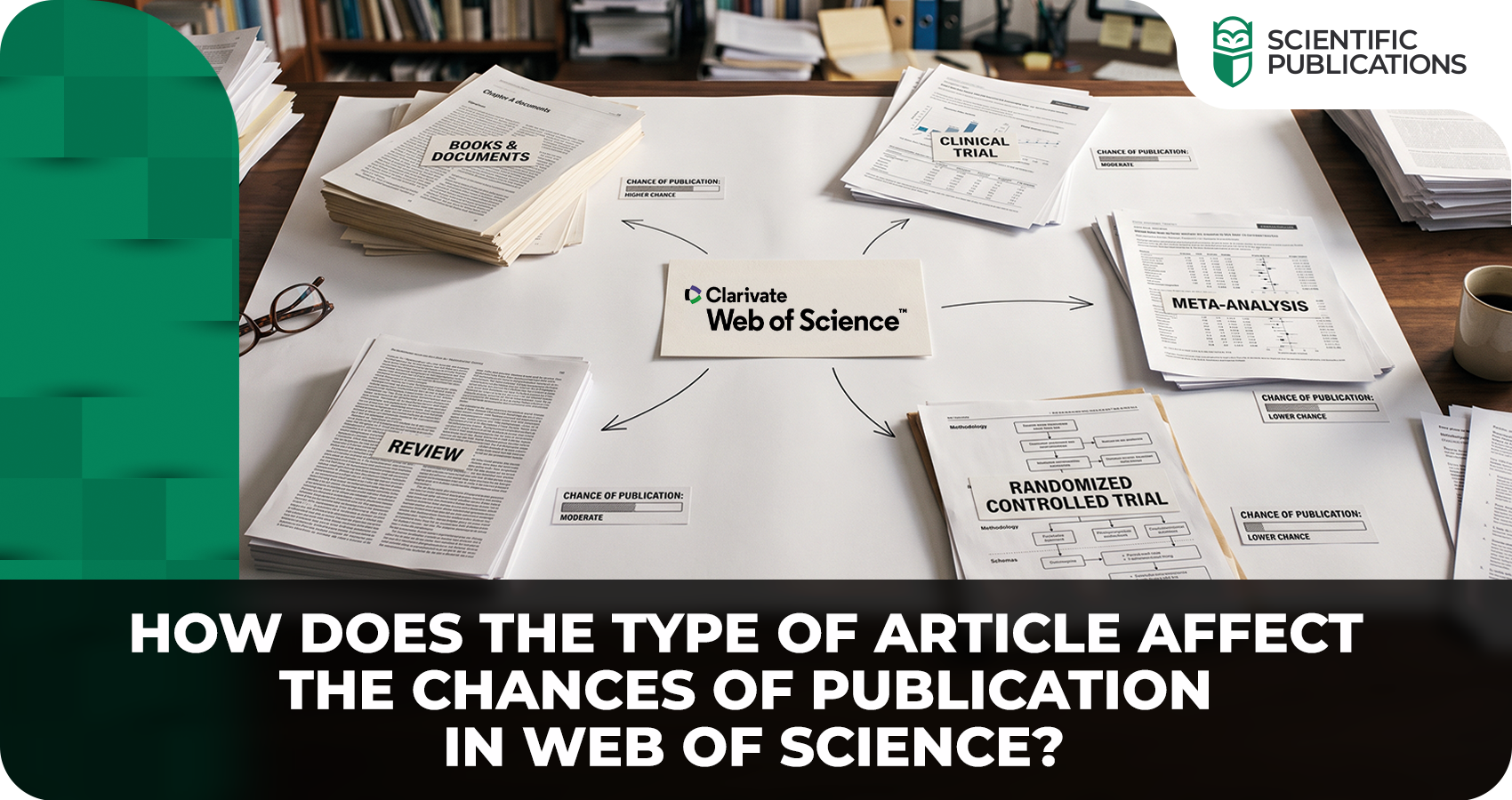
Does indexing in Web of Science depend on article type?
First of all, it is worth distinguishing between a manuscript being accepted by a journal's editorial team and its subsequent indexing. Web of Science does not accept articles directly from authors for publication – it is a bibliometric platform that receives content from journals and other scientific publications.
In Web of Science Core Collection, documents are classified by type, including articles, reviews, editorial material and letters. However, the database classification does not always fully correspond to the format designation used by the journal. For example, a short scientific communication or a fully documented clinical case may take the form of an article.
The manuscript type should primarily be checked against the guidelines of the specific journal. The mere fact that a journal is indexed in Web of Science does not mean that its editorial team accepts all types of scientific material.
What types of scientific articles do Web of Science journals accept?
Several main formats of scientific material are used in international publishing practice. Each has its own purpose, structural requirements and assessment criteria. These include the following:
- Original research article. Presents the results of the author's own research, describes the methodology, the data obtained and their interpretation. This format is suitable for authors who have completed a research project and can substantiate its contribution to the relevant scientific field.
- Review article. Summarises and critically analyses previously published research. It requires a thorough examination of the literature and a clear approach to selecting it. Some journals commission reviews from invited specialists, so the possibility of independent submission should be checked separately.
- Short communication. Intended for the concise presentation of research results. It usually has restrictions on text length and the number of tables, figures and references. The shorter format does not exempt the author from the need to substantiate the conclusions.
- Case report. Used primarily in medical sciences to present an individual clinical observation. Its value depends on how informative the case is for practice and what it adds to existing knowledge.
Some journals also accept methodological articles, materials describing datasets, commentaries and other formats. However, the editorial team itself determines the list of accepted article types, so the availability of a particular format in one journal does not mean that another will accept it.
Which article type has a higher chance of acceptance?
The editor primarily assesses the manuscript's relevance to the journal's scope, the significance of the research question, the scientific contribution of the work and its potential value to readers. If the material meets the editorial criteria, it may be sent for external peer review.
For example, an author may prepare a high-quality literature review but receive a rejection from a journal that publishes such material by invitation only. Similarly, a fully developed study may not be suitable for a journal focused on highly specialised results or a different format of material presentation.
It is also important to consider how closely the content of the work corresponds to the chosen article type. If an author has only preliminary results but presents them as a completed, large-scale study, the editorial team may question whether the evidence is sufficient. At the same time, excessively shortening the material to fit the Short Communication format may result in the loss of important methodological details.
Thus, what matters is not a particular article type designation but the alignment between the scope of the research, the nature of the results obtained and the requirements of the specific journal.
How does article type affect peer review?
Reviewers assess material according to its scientific objectives. For original research, the soundness of the methodology, the reliability of the results and the consistency of the conclusions with the data obtained are important.
When reviewing a review article, attention is paid to the comprehensiveness of the literature coverage, the logic of the analysis and whether the author provides a meaningful synthesis of existing knowledge. For systematic reviews, the transparency of the criteria for searching and selecting sources is also important.
A short communication must also contain sufficient information to assess the results. A shorter text does not mean that the editorial team will accept an incomplete description of the methods or insufficiently substantiated conclusions.
What should you check before choosing a publication format?
To avoid wasting time submitting a manuscript to a journal that does not accept the relevant type of material, it is worth checking the following aspects in advance:
- Aims and scope of the journal. Make sure that the research topic corresponds to the journal's scientific scope.
- Author guidelines. Check the list of accepted article types and the requirements for their structure, length and formatting.
- Recent issues. Pay attention to which formats the editorial team publishes and how studies related to your topic are presented.
- Submission conditions. Some types of material may be accepted only by invitation from the editor or after prior approval of the topic.
- Journal indexing. Use the official Master Journal List service to determine which Web of Science Core Collection index includes the journal.
It is also necessary to consider the purpose of the publication. If the article is being prepared for a dissertation defence, the award of an academic degree or the fulfilment of university requirements, you should separately check which document types are recognised under the current regulations. The presence of a record in Web of Science does not, in itself, confirm compliance with all academic assessment requirements.
Why should you not change the article type solely for the sake of publication?
The desire to adapt a paper to the requirements of a prestigious journal is understandable, but changing its format must be justified. Converting an original research article into a short communication or a review article into a research article does not eliminate methodological shortcomings or create new scientific results. Instead, correctly identifying the manuscript type helps the author understand, even at the preparation stage, which materials need to be collected, how thoroughly the methods should be described and what exactly needs to be substantiated in the conclusions.
It is advisable to develop a publication strategy alongside research planning, rather than after completing the article. This makes it possible to take the requirements of potential journals into account in advance, allow time for revising the material and avoid a situation in which the research has been completed but its format does not meet the conditions of the chosen journal.
Need help publishing an article in a Web of Science journal? Specialists at Scientific Publications will check the journal's current status and help you select a journal that matches your research profile. To receive a free consultation, complete the form below and our manager will contact you shortly. Together towards scientific achievements!