Choosing a co-author for a scientific publication is a responsible step that can significantly affect both the quality of the work itself and the success of its publication. In this article, we will look at the key factors to consider when choosing a co-author in order to avoid potential risks and get the most out of working together.
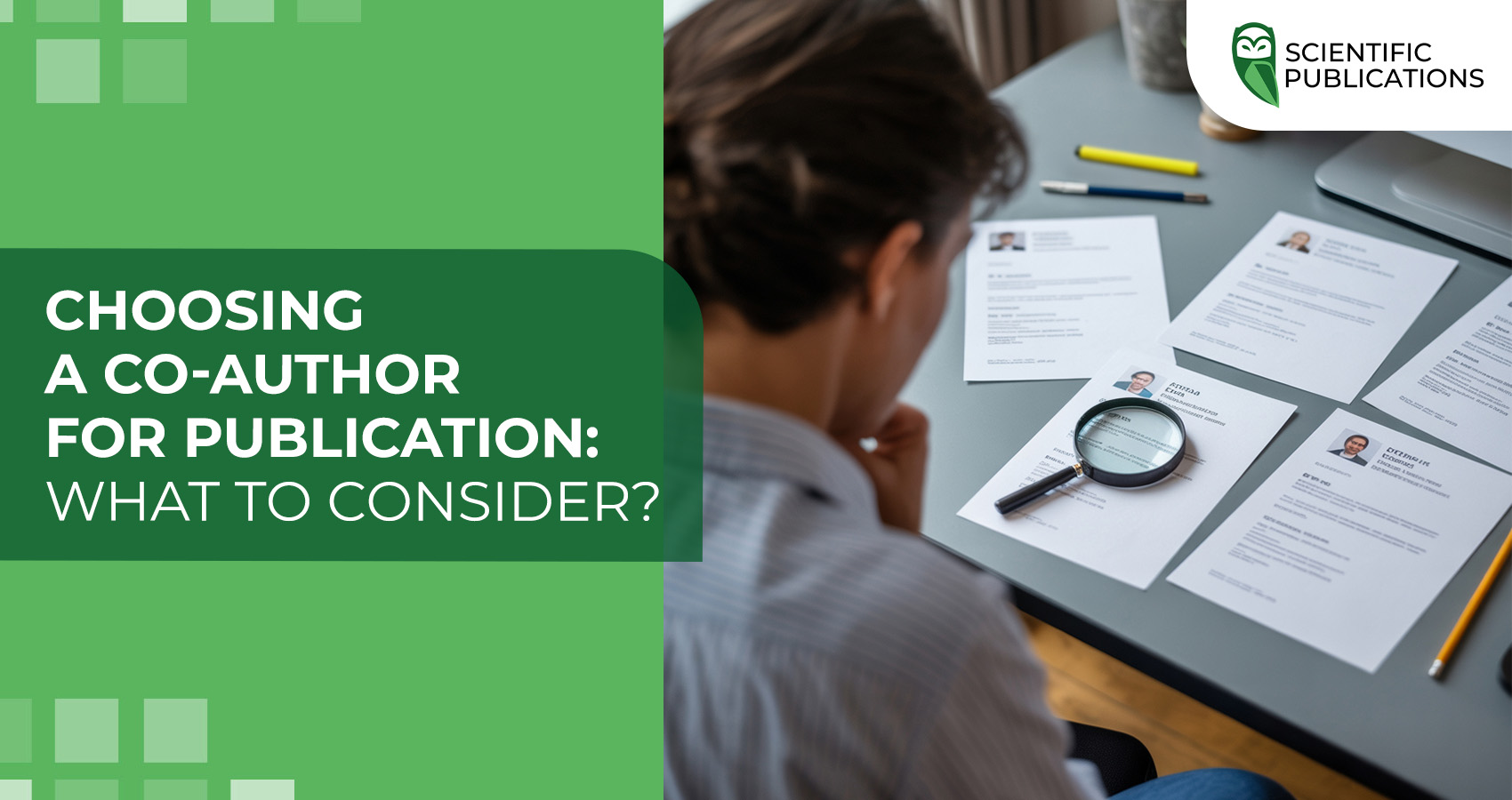
Scientists often decide to work as co-authors not only for reasons of financial cost sharing. They also choose teamwork to strengthen an interdisciplinary approach, draw on the experience of colleagues, or expand academic contacts. However, effective collaboration is only possible with a thoughtful approach to choosing a co-author. The right colleague can improve the quality of the research, while the wrong choice can lead to delays, conflicts, or ethical problems.
What is co-authorship?
Co-authorship is a scientific work created as a result of the joint efforts of several authors. Each co-author contributes to the research, preparation of material, or formatting of the article, etc. However, responsibility for the content of the research is shared among all participants. This form of collaboration allows for the pooling of expertise from different fields, improves the quality of scientific work, and distributes the workload and responsibility among all participants.
Co-authorship plays a significant role in modern scientometrics, as it allows for the contributions of several scientists to be recognised simultaneously and promotes the exchange of knowledge and research experience.
Who can be considered a co-author?
According to the recommendations of COPE (Committee on Publication Ethics), only those individuals who have made a significant intellectual contribution to the research should be included in the list of authors. They must participate in writing or substantially reviewing the manuscript. Authors must also approve the final version of the article and be prepared to take responsibility for the accuracy and integrity of all its parts.
In accordance with the recommendations of the ICMJE (International Committee of Medical Journal Editors), all co-authors must meet the following criteria:
- Significant contribution to the concept or design of the work; collection, analysis and/or interpretation of data.
- Drafting the work or critically reviewing it for important intellectual content.
- Final approval of the version to be published.
- Agreement to be accountable for all aspects of the work, willingness to properly address and resolve issues related to the accuracy or integrity of any part of the work.
These criteria are characteristic mainly of medicine and related fields, but they are the most widely recognised international standard for determining authorship.
What are the criteria for choosing a co-author?
Finding the right co-author is a strategic decision that significantly affects the quality of a scientific publication. An experienced and responsible colleague can not only strengthen the scientific basis of the research, but also simplify the process of writing the article and increase the likelihood of its publication in a reputable scientific journal. Below are the main criteria to consider when choosing a co-author.
Professional competence
One of the key criteria is that the co-author's scientific specialisation matches the subject of your research. The best option would be if their competence complements yours: for example, you are working on a sociological study, and your co-author has in-depth knowledge of statistical methods.
Such a symbiosis will increase the scientific value of the work, allow for a more in-depth analysis, and make the conclusions more substantiated. It is equally important to ensure that the potential co-author is truly capable of making a meaningful contribution to the research and is not participating formally, without actually contributing to the work.
Previous publication experience
The presence of publications in international databases, such as Scopus or Web of Science, is an important indicator of the co-author's scientific activity and experience. Experience working with such journals indicates that the researcher has already gone through complex editorial and review stages. They understand the requirements for article structure, academic style of presentation, correct formatting of references and illustrations, etc. This is especially important for young researchers who are just starting to publish.
An experienced co-author can:
- Help determine which type of journal is suitable for the chosen topic.
- Advise on how to properly adapt the structure to the requirements of a particular publication.
- Provide guidance on the submission process, formatting cover letters and responding to reviews.
- Suggest how to avoid common mistakes that often lead to articles being rejected.
In addition, it is equally important to ensure that the publication experience was the result of active participation in research. In other words, a co-author should not just appear on the list of authors, but should have real skills and an understanding of how a high-quality scientific article is structured.
Reliability in collaboration
When co-authoring, it is extremely important to have a colleague you can truly rely on. Publishing a study is a lengthy process with many stages. Each of these stages has its own deadlines that must be strictly adhered to.
If a co-author constantly delays their part of the work, fails to communicate, or avoids responsibility, it can delay or even derail the publication. To avoid this, it is worth discussing the following points at the outset:
- cooperation schedule and deadlines
- each person's areas of responsibility
- method and frequency of communication
Communication skills
Even if a person has in-depth knowledge of the research topic, this does not guarantee that they will be easy to work with. Communication is the basis of any collaborative work. This is especially true for the process of preparing a scientific article, which involves constant discussion of details, text correction, and agreement on important decisions. Poor or irregular communication can lead to:
- delays in working on a scientific article
- misunderstandings about structure or content
- conflicts over uncoordinated edits or author positions
- loss of motivation
Academic integrity
Collaborating with a dishonest author is a risk not only to your reputation but also to your career. Avoid authors who have a history of plagiarism, duplicate publications, manipulation of results, or artificial inflation of citations.
A reliable co-author must adhere to ethical standards: cite sources, not “multiply” authors without real contribution, and be transparent in their actions.
This can be verified by analysing their profile on Google Scholar, ORCID, Scopus or Web of Science as follows:
Google Scholar
- Go to the researcher's profile.
- Look at the topics of their publications: are they really related to their speciality?
- Check the number of co-authored works.
- Pay attention to the frequency of publications.
ORCID
- Find the profile by name or ID.
- Check whether specific participation in projects is indicated. ORCID often adds information about contributor roles, for example: ‘Data curation’, ‘Methodology’, etc.
- Also pay attention to the completeness of the profile and the relevance of the information in it.
Scopus and Web of Science
- Go to the Scopus database (via your personal profile or institution profile).
- Enter the author's surname in the search field.
- Pay attention to: the number of publications; research topics; journals in which the author has been published; the author's position in articles (first, last, etc.).
Tips for finding co-authors
- Look for researchers in your field. You can find them through academic platforms and social networks, such as Google Scholar, ResearchGate, or LinkedIn.
- Attend scientific conferences and actively communicate with other researchers. Present the results of your work and meet colleagues who may be interested in a common topic.
- Collaborate with colleagues at your institution or research group. Discuss your ideas; often, potential co-authors are already nearby and have relevant experience.
- Join scientific organisations and professional communities. This opens up opportunities to meet scientists who share your scientific interests and may become partners in publications.
- Use social networks. In particular, use X or LinkedIn to establish scientific contacts. Also, join online forums and thematic discussion groups in your field.
- Ask colleagues or scientific supervisors for recommendations. They can recommend reliable researchers who are interested in collaboration or are looking for co-authors for their own projects.
Successful co-authorship is based on openness, mutual responsibility, and clear planning. Careful selection of a co-author will not only help you avoid conflicts in the future, but also allow you to gain advantages in the scientific publishing environment.
Get the most out of co-authorship with Scientific Publications! Need to publish a scientific article? We will help you find the right journal and guide your work to successful publication. Get a free consultation by filling out the form below, and a manager will contact you shortly. Together to successful publication!